Rules
In this book club you will discuss Orbital by Samantha Harvey in a small group of 4-6 readers. You will start a conversation by responding to discussion questions about the text. The book club opens with a brief introduction that one of you reads out loud. The book club then continues in four rounds:
- Round 1 consists of 5 quiz questions about the text. One of the group members acts as the quiz master who reads each question out loud, after which everyone (including the quiz master) writes down their answer. The correct answers will appear on the screen after you have turned over the final question card. You may then check your answers and calculate your scores.
- Round 2 consists of genuine questions that you have. Each group member consults the group about a part of the text that they thought was unclear. Together, you try to find answers to the questions that are raised. After everything has been cleared up, your group is ready to proceed to the next round.
- Round 3 consists of questions for discussion. There are two categories to choose from. The person with the most correct answers to the quiz questions gets to be the first to turn over a card and respond to the question. The other members of the group may then add to the discussion by responding and sharing their ideas. Take turns until all cards are flipped.
- Round 4 is when you get to review the text. How many stars would you give the text and why? Discuss this together until you have reached a shared verdict. Use the text box to explain your choice.
Introduction
‘But what he meant to say to his daughter – and what he will say when he returns – is that progress is not a thinking but a feeling, it’s a feeling of adventure and expansion that darts in the belly and works up to the chest (and so often ends in the head where it tends to go wrong). It’s a feeling he has almost perpetually when here.’ (p. 53)
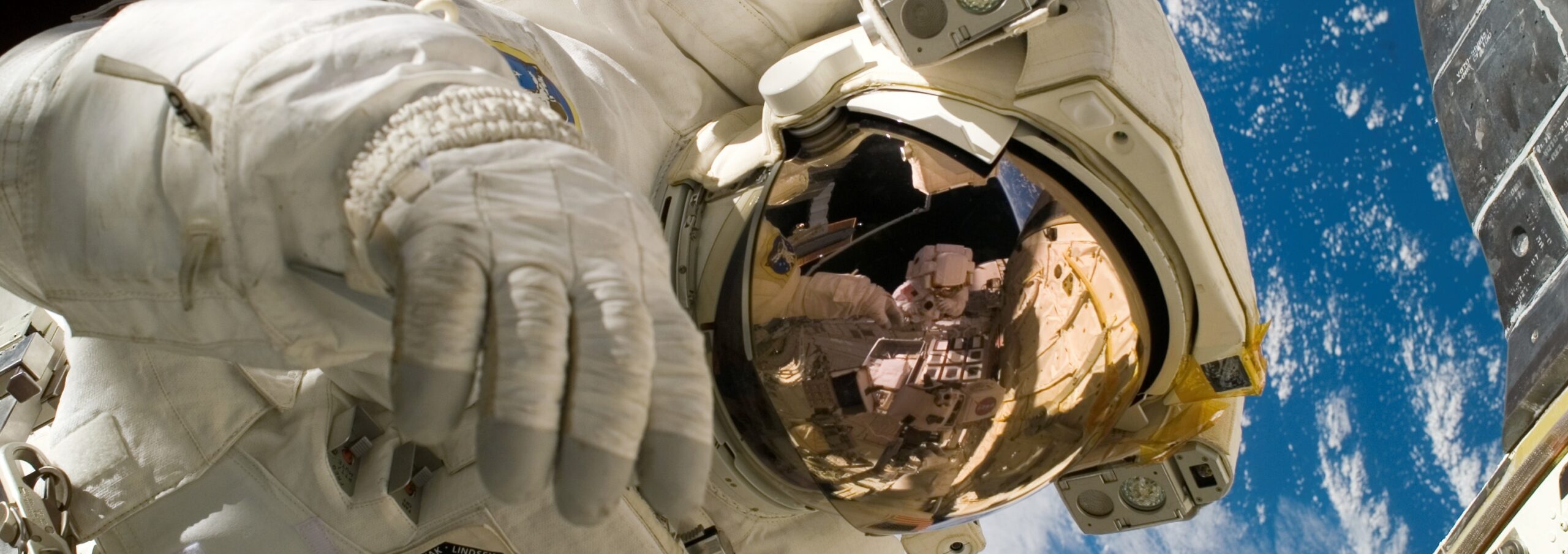
Orbital, by Samantha Harvey, takes the reader along on an introspective journey as six astronauts and cosmonauts orbit Earth again and again. While carrying out the routine tasks and experiments assigned to them, the experience of viewing Earth from a distance triggers personal memories and contemplation. Travelling through space at 17,000 miles per hour the crew tries to maintain a semblance of human life as they know it.
Through an almost plotless structure and with hardly any dialogue, the novel explores themes of time, space, human connection, and the beauty of the planet below. Watching Earth from space changes the crew’s understanding of borders, progress, and humanity itself, creating a perspective that feels both deeply personal and universal. Through observation and repetition, Orbital suggests that space travel reshapes how people understand themselves and the world they inhabit. This book club invites you to discuss these ideas about space, science, and the fragility of Earth.
Round 1: Quiz
Quiz question
1. Which countries are represented by the astronauts and cosmonauts?
2. Who experiences the loss of a loved one during their time in space?
3. Time takes on a different meaning in space. How much time passes in the novel?
4. Which natural event on Earth becomes a recurring source of concern for the crew?
5. How do the different countries try to maintain separation between nationalities within the station?
Answers
1. Japan, USA, Russia, Great Britain (Nell’s partner is Irish, but Nell is from GB), and Italy
2. Chie
3. one day (and 16 orbits)
4. a major typhoon/hurricane
5. The national agencies claim resources for their own astronauts, such as toilets for Russians only.
Round 2: Initial questions
What questions popped into your head while reading Orbital? Were there any parts that left you confused or wondering? Take turns sharing your questions about the story and try to come up with answers together. Use evidence from the text to support your ideas.
Round 3: Discussion
Personal connections?
Card 1/8 - Personal connections?
1. After learning that her mother has died, Chie chooses to allow the funeral ceremony to take place without her. Why do you think she makes this decision? If you were in a similar situation, what factors or personal values would influence your choice?
Card 2/8 - Personal connections?
2. Throughout Orbital, Harvey describes several physical effects that living in space has on the human body, such as changes caused by weightlessness, for example. What are some of these effects? Do you think you would be willing to accept these physical sacrifices in order to experience life in space? Explain your answer.
Card 3/8 - Personal connections?
3. Read the quote from the introduction. Pietro is asked by his daughter if ‘progress is beautiful’ and she is critical of his initial answer. Which distinction does Pietro make in response? How do you see ‘progress’ and should we always endeavour to pursue it?
Card 4/8 - Personal connections?
4. The novel describes the ‘sounds of Earth’ recorded on the Voyager 1 and Voyager 2 spacecraft, which were sent into space to represent humanity to possible intelligent life. What does this detail suggest about which country launched these missions? What kinds of sounds, images, or information do you think would be most important to include in a message meant for extraterrestrial life, and why?
Card 5/8 - Personal connections?
5. Nell’s pursuit to become an astronaut was not triggered by the moon landing but by the space shuttle Challenger. Why might this choice seem unexpected or unusual? Has fear ever motivated you to try even harder or can you imagine how fear can be a motivator to reach new goals?
Card 6/8 - Personal connections?
6. Anton discovers a lump in his neck but chooses not to tell the other astronauts or the assigned doctor. Why do you think he makes this decision? If you were in his situation, would you act the same way or differently? Explain your reasoning.
Card 7/8 - Personal connections?
7. In the novel, life aboard the space station is often described in terms of what is missing compared to life on Earth. Think of two key aspects of Earthly life that are absent in space. Include a quotation from the novel for each example to support your answer. Then reflect: do you think being human is tied to living on Earth, or can humanity exist equally well in space? Explain your view.
Card 8/8 - Personal connections?
8. The novel often focuses on silence and observation rather than action. How did this style affect your reading experience? Did you find this calming, meaningful, frustrating, or something else? Explain your response.
Personal connections?
That was the last card!
Food for thought?
Card 1/8 - Food for thought?
1.Roman frequently tries to contact people on Earth using packet radio. Why do you think he does this? What does the novel suggest about his character through these actions? Use evidence from the text in your answer.
Card 2/8 - Food for thought?
2. The narrative perspective in the novel shifts between different characters. What effect does this have on the reader’s understanding of the story and its themes? Include at least one example or passage from the novel to support your answer.
Card 3/8 - Food for thought?
3. In a discussion about the subject of Velázquez’s painting Las Meninas, Pietro says to Shaun: ‘it’s the dog,’ which is something Shaun had never even considered. What might this suggest about how perspective influences understanding? It might be helpful to first look up the painting to give your discussion further depth. Explain your ideas.
Card 4/8 - Food for thought?
4. Chie creates several lists during the novel, of irritating things, reassuring things, surprising things and finally of anticipated things. How do these contribute to her characterisation?
Card 5/8 - Food for thought?
5. In the novel, a destructive typhoon is presented more as a background event than a central focus. How does this distance shape the reader’s experience? Explain your answer.
Card 6/8 - Food for thought?
6. The novel pays very little attention to its characters or their development. They merely serve as a framework for the broader perspective of the story. How does this limited focus on individual humans relate to the novel’s perspective from outer space?
Card 7/8 - Food for thought?
7. Would you classify Orbital more as a science fiction novel or a realist novel? Give at least two reasons to support each interpretation, using examples from the text.
Card 8/8 - Food for thought?
8. How might the novel change if there were more conflict and tension between the characters? Would this make the story more engaging for you? What might be gained, and what might be lost, if the novel focused more on conflict? Include at least one specific example.
Food for thought?
That was the last card!
Round 4: Review
Review Orbital by rating the novel on a scale of one to five stars, and then provide an explanation for your choice. Discuss what aspects you enjoyed and what aspects you didn’t, and provide reasons for your opinions. Reflect on whether the discussion influenced your individual perspective, and if so, how. Incorporate examples and arguments from your responses to the discussion questions to support your review.